
Honeycomb Ceramic Substrate
Cordierite honeycomb monolith with extremely low thermal expansion, high specific surface area and rapid light-off, used as the carrier medium for oxidation and reduction catalyst.

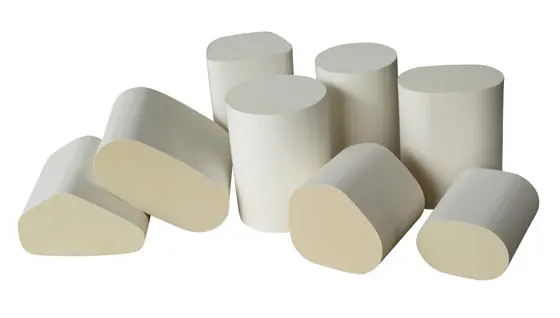
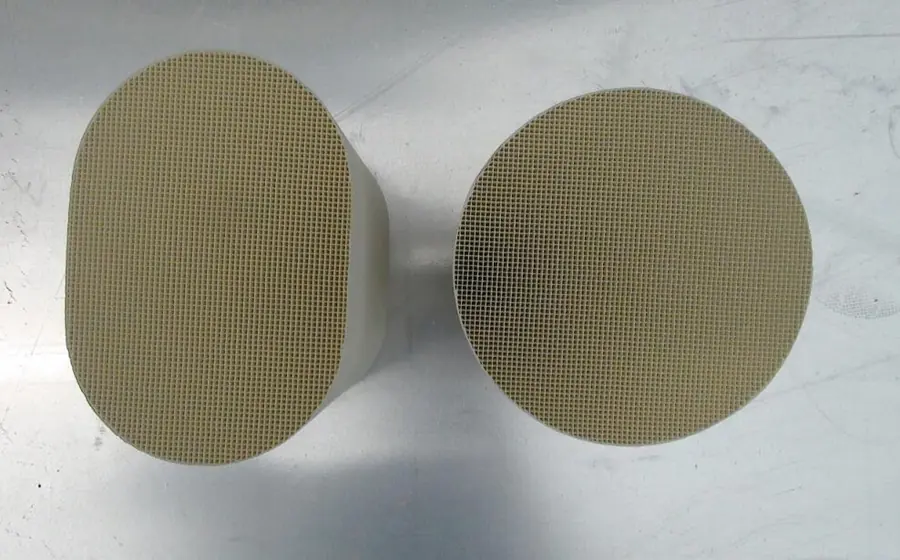
Honeycomb Ceramic Substrate
Product Overview
PRUITING® advanced honeycomb substrate is made from cordierite material and can be used at temperature up to 1350 °C. Because of its nature of crystallization, crystal-chemical formula cordierite has extremely low coefficient of thermal expansion. High specific surface area, low pressure drop, rapid light-off time and reliable & durable performance are achieved through high cell density of 400 and 600 CPSI.
Honeycomb-like structure with thousands of parallel channels forces exhaust gases into the turbulent flow regime resulting in better contact between emission and precious metal, enhanced mass-transfer conditions, and higher conversion efficiency.
All of these make our ceramic honeycomb an ideal catalyst substrate media for oxidation & reduction catalyst. Current, our typical substrate are available in a variety of sizes with the different shapes, such as: round, elliptical, race track and so on.
Key Benefits
Technical Features and Key Benefits
- Made from cordierite material and can be used at temperature up to 1350 °C
- Extremely low coefficient of thermal expansion because of the crystal-chemical nature of cordierite
- High specific surface area and low pressure drop
- Rapid light-off time and reliable, durable performance through high cell density of 400 and 600 CPSI
- Thousands of parallel channels force the exhaust into turbulent flow for better contact with the precious metal
Who It Is For
Buyers Who Specify This Product
- Catalyst coaters producing three-way catalysts for gasoline vehicles
- Catalytic converter manufacturers serving OEM and aftermarket programmes
- Emission control system builders who need round, elliptical or race track carriers
Problems It Solves
What It Fixes in the Exhaust Line
- Thermal shock cracking of the carrier under repeated heating and cooling
- Insufficient contact between exhaust gas and precious metal, which limits conversion efficiency
- Excessive back pressure caused by an unsuitable cell density
Specifications
Published Sizes and Technical Data
Our universal specification and size:
(A) Specification of 100 aperture/inch2-600 aperture/inch2 typical products in round shape:
| NO. | Specification | No. | Specification | No. | Specification |
|---|---|---|---|---|---|
| 1 | Ø76.2×50 | 11 | Ø101.6×123.4 | 21 | Ø118.4×120 |
| 2 | Ø80×60 | 12 | Ø103×100 | 22 | Ø118.4×152.4 |
| 3 | Ø83×60 | 13 | Ø103×130 | 23 | Ø118.4×136 |
| 4 | Ø83×125 | 14 | Ø106×80 | 24 | Ø150×100 |
| 5 | Ø83×85 | 15 | Ø106×130 | 25 | Ø170×100 |
| 6 | Ø93×60 | 16 | Ø106×152.4 | 26 | Ø105.7×152.4 |
| 7 | Ø93×101.6 | 17 | Ø110×130 | 27 | Ø105.7×130 |
| 8 | Ø93×152.4 | 18 | Ø110×150 | 28 | Ø97×170 |
| 9 | Ø100×100 | 19 | Ø112×80 | 29 | Ø194.5×101.6 |
| 10 | Ø101.6×76 | 20 | Ø118.4×100 | 30 | Ø105.4×80 |
(B) Specification of 100 aperture/inch2-600 aperture/inch2 typical products in racetrack shape and ellipse:
| NO. | Specification | NO. | Specification |
|---|---|---|---|
| 1 | 80×57×85 R21.5 | 11 | 169.7×80.8×152.4 R37.2 |
| 2 | 99.8×68.1×120.6 R33.6 | 12 | 177.8×114.3×170 R44.9 |
| 3 | 112×60×90 R28 | 13 | 169×85.7×127 R30 |
| 4 | 120.6×80×152.4 R39.6 | 14 | 127×61×120.7 R23 |
| 5 | 144×68×152.4 R28.4 | 15 | 130×85×150 R41 |
| 6 | 144.3×68.1×152.4 R32.2 | 16 | 112×60×80 R28.3 |
| 7 | 144.8×81.3×152.4 R37 | 17 | 148.6×83.4×81 R38 |
| 8 | 147×76.5×76 R30 | 18 | 148.6×83.4×163 R38 |
| 9 | 147×95×152.4 R36.6 | 19 | 131×86×80 R35 |
| 10 | 148×84×152.4 R38 | 20 | 125×80×125 R32 |
(C) Specification of 100 aperture/inch2-600 aperture/inch2 typical products in irregular shape:
| NO. | Specification | NO. | Specification |
|---|---|---|---|
| 1 | Triangle144×84×76 | 11 | Trapezium122.3×104.4×80 |
| 2 | Triangle144×84×155 | 12 | Rectangle119.5×99.5×115 |
| 3 | Triangle143.5×84×155 | 13 | Irregular shape 114×105×115 |
| 4 | Triangle144×84×130 | 14 | Irregular shape 114×105×85 |
| 5 | Triangle144×84×152.4 | 15 | Irregular shape 114×105×110 |
| 6 | Triangle 144×84×50 | 16 | Irregular shape 114×105×80 |
| 7 | Trapezium112.2×92×152.4 | 17 | Pear shape 120.2×108×75 |
| 8 | Trapezium112.2×92×50 | ||
| 9 | Trapezium112×91×152.4 | ||
| 10 | Trapezium122.3×104.4×80 |
Figures above are reproduced from the PRT published specification. Dimensions in mm unless stated otherwise. Ø denotes diameter.
FAQ
Honeycomb Ceramic Substrate FAQ
What material is the substrate made from?
It is made from cordierite material, whose crystal-chemical structure gives an extremely low coefficient of thermal expansion.
What is the maximum working temperature?
The honeycomb substrate can be used at temperature up to 1350 °C.
Which cell densities are available?
Rapid light-off and durable performance are achieved through high cell density of 400 and 600 CPSI. The published specification tables cover 100 aperture/inch2 to 600 aperture/inch2.
Which shapes can you supply?
Typical substrates are available in a variety of sizes with different shapes, such as round, elliptical and race track. Triangle and trapezium irregular shapes are also listed in the specification table.
Can you supply a size that is not in the table?
The tables show our universal specification and size. Send your drawing or dimensions by email and our engineers will confirm feasibility.
Related Products
Often Specified Together
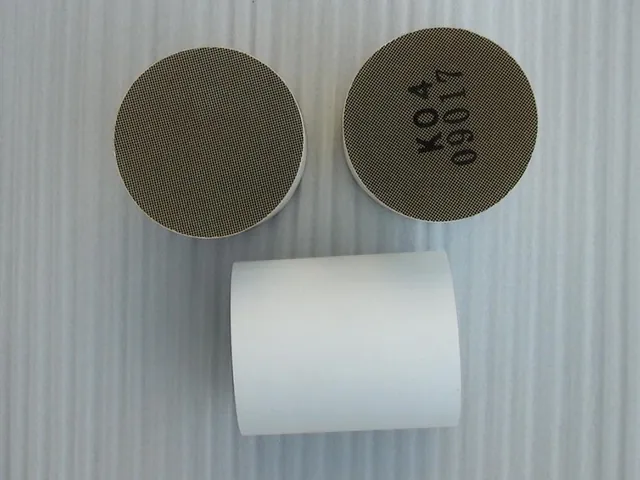
Ceramic Catalyst
Three-way catalyst coated on ceramic honeycomb, Euro III to Euro V, 80,000 km least life time.
View Product →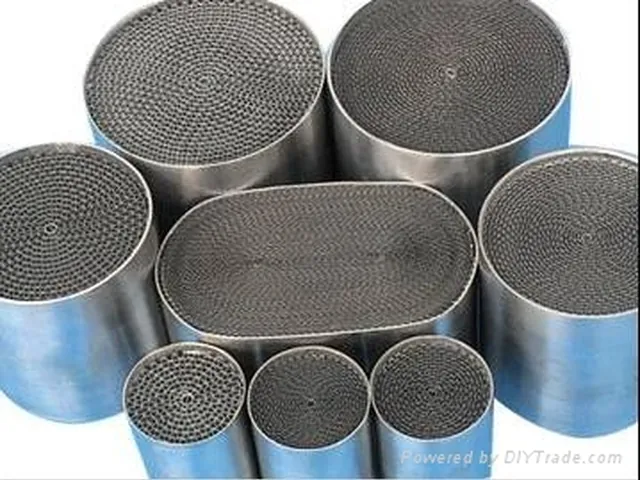
Metallic Substrate
Thin steel foil metallic carrier from 0.5" to 39.50" diameter, 100 to 1000 CPSI.
View Product →
Diesel Oxidation Catalyst Substrate
Cordierite DOC carrier, diameter 144 mm to 381 mm, 100 to 400 CPSI.
View Product →